Area Pro Sensor

Ultimate Coverage. Ultimate Precision.

The ultimate occupancy sensor for enterprise workplace teams

Years of research and development. Multiple breakthroughs. Built on the legacy of XY Sense’s original market-defining Area Sensor, Area Pro delivers a new standard in single-sensor occupancy intelligence.

Occupancy data you can trust

Instant detection with ~99% accuracy to within 0.5 ft / 20 cm across 3,000 sq ft — industry-leading performance.

AI features that unlock workplace ROI

Go beyond attendance basics with advanced insights into space utilization, dwell time, movement patterns, and behavioral trends.

Lower Total Cost of Ownership

Up to 50% fewer sensors, 80% less cabling, no network switches, and no battery replacements — dramatically lowering lifetime costs.

Deployed in Area Mode or Entry Mode (coming soon).

One versatile super sensor that can be deployed in Utilization Mode or Count Mode (coming soon) Smaller form factor, flexible connectivity, and significantly less cabling.

The enterprise occupancy sensor, redefined.

Please supply

3X Coverage

Deploy up to 50% fewer sensors without sacrificing insight, thanks to the industry’s largest occupancy coverage—up to 3,000 sq ft (279 m²) or 28+ desks per sensor. With 2–3x the tested range of leading alternatives, you get broader visibility, lower hardware costs, and simpler deployments.

Please supply

~99% accuracy

Instant detection with ~99% accuracy to within 0.5 ft / 15 cm across 3,000 sq ft. Market-leading performance delivers precise, real-time visibility at scale—so you can trust your workplace data to drive smarter space planning and confident decisions.

Please supply

Lighting-fast, on-device AI Compute

Able to detect up to 255 people simultaneously and designed to unlock advanced AI features (Paths of travel, pose recognition, building automation triggers). Creating a future-ready sensing platform that will keep getting better through over the air updates.

Please supply

One versatile super sensor, deployable in Area Mode or Entry Mode (coming soon).

Area Pro delivers flexible performance to meet evolving workplace needs with a single, future-ready device.

Please supply

The sensor for smarter buildings & actual ROI

Not just insights. Action. Precise occupancy sensor data aggregated fast enough to automate HVAC, lighting, booking release, cleaning, and energy. Create a space that can respond to changes, not just reports on what happened.

Please supply

Designed to disappear.

A 40% smaller, lower-profile sensor designed for reduced power consumption and lower carbon impact—delivering high performance with a lighter environmental footprint.

Please supply

Reliability at Scale. No Batteries. No Compromise.

Built for truly data-driven workplace teams, with 80% reduced cabling via SenseLink PoE, zero battery maintenance, and enterprise-grade uptime and warranty protections for reliable, scalable performance.

Smart, private, real-time occupancy detection

NEED CONTENT The motion-activated, privacy-preserving XY Sense Presence sensor works in real time to detect human occupancy in the monitored space.

Once motion has been detected, each Presence Sensor interacts wirelessly (via LoRaWan) with the Presence Gateway. The Presence Gateway can support hundreds of Presence Sensors on a given floor and is securely powered from the XY Sense Gateway.

See how the Area Pro compares

Others
Coverage 500sqft - 1,000sqft3,000sqft
Positional Accuracy / Precision75-90% accuracy 99% accuracy (within 1ft in 2 secs)
Real-time data 2-5 min updates 2 seconds
Privacy-preserving
Live views & displays
Specalized workplace analytics & AI features
API for Integrations
Deployment OptionsNever-ending battery maintenanceSenselink Daisy Chain (80% less cabling, 100% uptime)

Book a confidential discussion to see how we compare to specific solutions you may be evaluating.

Proprietary technology for data-driven workplace teams.

Area Pro is XY Sense’s enterprise-built sensor, engineered for global scale with reliable, battery-free performance and no data gaps.

See our platform working live

See our platform working live

We take your team’s privacy seriously

We know you want to use office occupancy and utilization data to create awesome workplace experiences, not keep tabs on your people. That’s why, XY Sense has been designed to only ever capture the XY coordinates of individuals relative to a sensor.

We take your team’s privacy seriously

We know you want to use office occupancy and utilization data to create awesome workplace experiences, not keep tabs on your people. That’s why, XY Sense has been designed to only ever capture the XY coordinates of individuals relative to a sensor.

Taking the guesswork out of your workplace

Understand how many people are attending office locations on a given day as well as space utilization trends within workplace environments.

Benchmark occupancy and utilization by team or neighborhood and understand how your return to office strategy is really tracking.

Feeling the pressure to reduce real estate costs in a hybrid work world?

With occupancy insights from XY Sense, you can rightsize your commercial space and net lease expenses while enhancing your workplace. XY Sense gives you the real-time information and data you need to cut operating costs, validate space types, and create more engaging environments.

As companies move to hybrid workplace settings which see attendance vary dramatically across the week, it’s become more complicated to define the quantity and types of office space needed to support employees.

XY Sense removes the guesswork from applying outdated allocations and ratios, helping you create productive spaces that your teams will love.

Workplace analytics can be used to deliver smart facilities outcomes by ensuring that utilities, cleaning, concierge and other services are delivered based on real-time occupancy or historical demand- not guesswork.

With help from XY Sense, workplace teams can also help businesses to meet their environmental goals by minimizing their carbon footprint.

It’s time to take the guesswork out of your commercial real estate strategy. With XY Sense, the future is mapped with clarity, ensuring you don’t waste millions on empty, unloved and underutilized workplace locations.

With highly accurate data and reporting on the occupancy and utilization of your portfolio, you are armed with the knowledge needed to improve space efficiency, inform lease planning, and right-size your real estate footprints.

By integrating data from leading air quality solution providers, we’ve combined air quality metrics with real-time occupancy data to offer deeper insights into space utilization and building performance.

Solution brief
Solution brief

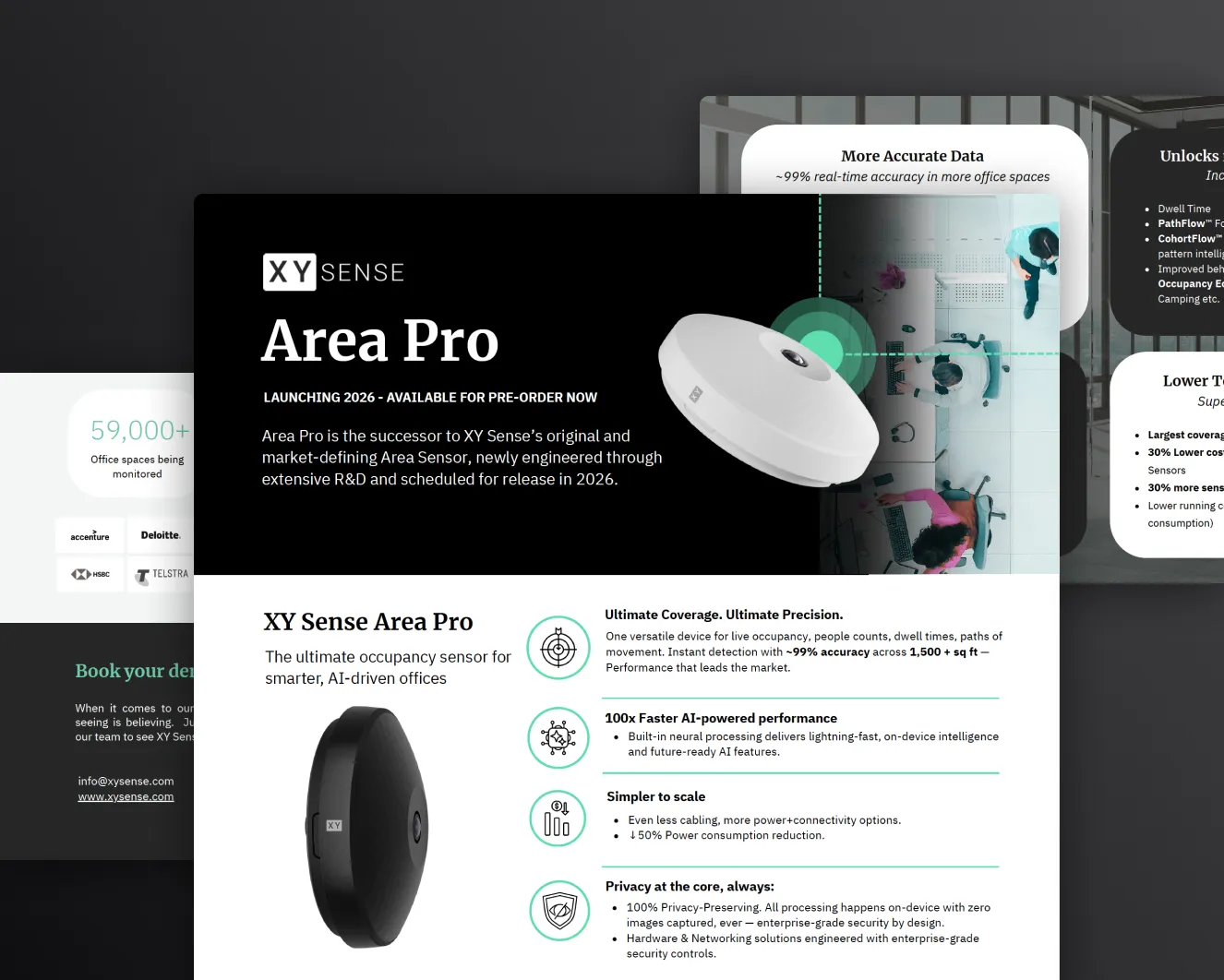
Area Pro Solution Brief

Powered by the latest developments in AI, the XY Sense Area Pro is the ultimate privacy-preserving occupancy sensor for workplace teams.

Download your copy

The XY Sense Area Pro is an enterprise-grade wide-area occupancy sensor that uses AI and computer vision to measure how people use physical spaces in real time. Mounted on the ceiling, the sensor detects anonymous human movement and location across large areas—up to 3,000 square feet (279 m²)—with approximately 99% real-time detection accuracy. 

Organizations use Area Pro sensors to understand workplace utilization, optimize office layouts, automate building systems such as HVAC and lighting, and improve employee experience through real-time space insights.

Area Pro is the next-generation version of the original XY Sense Area Sensor, offering significantly greater coverage, more powerful AI processing, and expanded deployment capabilities.

Key improvements include:

Coverage
• Area Pro: ~3,000 sq ft per sensor
• Original Area Sensor: ~1,000 sq ft per sensor

This allows organizations to monitor significantly larger areas with fewer sensors.

Advanced AI processing
Area Pro includes integrated neural processing that will enable advanced analytics such as dwell time analysis, paths of travel, and behavioral insights such as sit vs stand detection. 

These feature capabilities are being rolled out by XY Sense through software updates without replacing hardware.

Higher occupancy capacity
Area Pro can detect up to 255 people simultaneously within a single sensor’s coverage area.

Dual-mode functionality
Area Pro will introduce two operating modes for a single ceiling-mounted occupancy sensor:
• Area Mode — detailed spatial utilization insights
• Entry Mode (coming via firmware update) — highly accurate threshold counting

Simplified infrastructure
Area Pro uses SenseLink® daisy-chain architecture, reducing cabling requirements compared with traditional PoE installations.

A single Area Pro sensor covers up to 3,000 square feet (279 m²) or approximately 28+ desks. This coverage is up to three times greater than many competing occupancy sensors, allowing organizations to deploy fewer devices across an office floor while reducing hardware costs and installation complexity.

Area Pro provides approximately 99% real-time occupancy detection accuracy. The sensor detects people within roughly 0.5–1 foot of their location and updates occupancy insights every 2 seconds. It can track up to 255 people simultaneously within its coverage area.

No. Area Pro is designed with privacy-first architecture. The sensor processes visual data locally on the device and does not capture, store, or transmit images of people or workplaces. Instead, the system outputs anonymous coordinate data representing where people are located within a space.

Corporate real estate and workplace teams use Area Pro to understand how office space is actually used, reduce real estate costs, improve employee workplace experience, automate buildings based on real occupancy data, and improve sustainability and energy efficiency. Occupancy intelligence allows organizations to make data-driven workplace decisions about space planning, workplace experience, and operational efficiency.

An area sensor (also called a wide-area occupancy sensor or overhead occupancy sensor) monitors occupancy across large areas of a building from a single installation point. Area sensors are typically installed on the ceiling and track how people move through open spaces such as office floors, collaboration areas, meeting zones, and shared workspaces. Unlike desk sensors or entry sensors, can simultaneously monitor multiple desks, collaboration areas, and pathways within their coverage zone, providing detailed insights into how entire spaces are utilized. The best sensors track the locations of people within the zone and their movements. Using area sensors, workplace leaders can measure and understand how and when people are using a space.

These are all terms that refer to the same type of device. The industry uses various naming conventions, but they all describe sensors that monitor occupancy across broad areas from overhead installations. Companies use different brand names for their area sensor products—for example, XY Sense provides “Area Sensors.”, Butlr calls theirs “Heatic™,” VergeSense uses “Area Sensors,” and Density offers “Open Area Sensors.” Despite the different naming, these are all wide-area occupancy monitoring solutions that track people across floors or zones.

The key is to compare the coverage range and positional accuracy provided by different solutions to understand which solution can provide the most value for money for your own workplace.

Area sensors monitor how spaces are used by tracking people throughout a space, while entry sensors count people entering or exiting a room or threshold. Area sensors provide insights into where people are located, how long they stay, and how they move through spaces. Entry sensors provide simpler metrics such as room occupancy counts.

While entry sensors tell you how many people went in or out, area sensors provide comprehensive insights into how the entire space is being used, including where people are located, how long they stay, and which specific areas or resources are most utilized. Both entry sensors and area sensors can be part of an occupancy analytics installation, but they serve very different purposes. 

Area Pro supports both use cases through its dual operating modes.

Desk sensors monitor individual workstations or specific pieces of furniture, typically providing a binary occupied/vacant status for single desks. Area sensors monitor entire zones simultaneously and can track multiple desks, collaboration areas, and pathways from a single installation point. While you might need 20 individual desk sensors to monitor 20 workstations, one or two area sensors can track 20 desks plus the surrounding circulation and collaboration spaces, providing more comprehensive utilization insights. The number of area sensors required to monitor a space varies by manufacturer and technology. For example, XY Sense Area Sensors monitor about 1000 SF or enough space for ~20 desks, while competing sensors typically monitor about 500 SF.

Small-space sensors (for example, XY Sense Presence sensors) are designed for compact, enclosed environments such as phone booths, focus pods, or small meeting rooms. These sensors typically provide binary occupancy detection.

Area sensors are designed for large, open spaces and can simultaneously monitor multiple zones, track detailed movement patterns, and provide precise location data across much broader areas. Small space sensors are typically less costly than area sensors, reflecting their more limited tracking capabilities.

Area sensors and IAQ sensors serve complementary but distinct roles.

Area sensors measure human occupancy and movement patterns to understand how spaces are used. IAQ sensors measure environmental conditions such as CO₂ levels, temperature, humidity, particulates, and volatile organic compounds.

Both provide important insights for comprehensive building intelligence. Area sensors tell you how spaces are used and by how many people. In contrast, IAQ sensors ensure those spaces maintain optimal environmental conditions for health and productivity. Many advanced building systems integrate both types of sensors to create responsive environments that adjust both space allocation and air quality based on actual occupancy patterns. Together they enable intelligent building management by linking environmental conditions with real occupancy data.

 Area sensors use several core technologies: 

  • Computer vision sensors anonymously analyze visual data using AI, providing the most accurate occupancy counts, location data, and movement pattern insights. Accuracy for these sensors approaches 99%. XY Sense Area Sensors are the most accurate computer vision sensors available. They also deliver advanced privacy controls through edge processing. This ensures that no images of people, office scenes or personal information of any kind is ever available 
  • Passive infrared (PIR) sensors detect heat signatures from human bodies, providing data on whether individuals are present in an area. They are less accurate than computer vision sensors. Some measure only whether one or more people are using a space, while others try to provide insights into the number and locations of individuals in a space. Accuracy for PIR sensors is typically estimated at 90-95%.
  • WiFi-based occupancy analytics leverage wifi signals to detect the presence of active devices in a space. From there, they use algorithms to probabilistically determine how many individuals are in a space and their location. Great progress has been made to improve the accuracy of these algorithms, but the level of accuracy for sensors using this technology tends to be far lower – typically 60-80%. XY Sense has prepared a guide which details the pros and cons of this technology in detail, download here. 

While these accuracy figures may seem similar, it’s important to understand that a few points of accuracy can make an enormous difference in the precision and utility of workplace sensor data and insights. With lower accuracy, companies must build a significant buffer into their workplace plans to ensure there are enough desks, meeting rooms, and resources available. Learn more about the technologies and differences here.

Accuracy varies significantly by technology.

Computer vision sensors can reach approximately 99% accuracy.
PIR sensors typically provide around 90–95% accuracy.
WiFi-based occupancy analytics often fall between 60–80% accuracy.

Even small differences in accuracy can significantly impact decisions about space planning, HVAC optimization, safety compliance, and real estate strategy.

Area sensors can be powered through wired connections (Power over Ethernet/PoE) or battery systems. 

  • Wired systems are projected to dominate the market, reaching $4.3 billion by 2032, due to strong demand in large-scale commercial installations. Their consistent power delivery and dependable operation make them particularly well-suited for commercial and industrial environments. Continuous power availability enables them to scan a space in real-time for maximum insight. For example, XY Sense Area Sensors scan an area every two seconds, versus many battery-operated sensors that scan just 4-6 times per hour. Advanced systems offer innovative installation options like daisy-chaining multiple sensors from a single power source, significantly reducing cabling requirements and installation complexity.

Battery-powered systems are also popular due to their ease of installation and flexibility in retrofitting to existing infrastructure. However, battery-operated sensors cannot offer real-time tracking because constant space monitoring would require too much power and drain device batteries rapidly. They tend to scan a space occasionally every hour, often about every 10-12 minutes. The data provided are thus far less useful for understanding true occupancy and movement patterns. They also produce significant toxic e-waste in disused batteries, which hinders companies’ efforts for sustainability. They also require frequent battery replacement, introducing demands on your facilities team. Further, data is lost when batteries fail.

The number of sensors required depends on office size, layout complexity, and sensor coverage. Because Area Pro covers up to 3,000 square feet per device, organizations may require significantly fewer sensors compared with traditional occupancy sensing solutions.

Example deployment estimates include:

10,000 sq ft office — approximately 3–4 sensors
25,000 sq ft office — approximately 8–10 sensors
50,000 sq ft office — approximately 15–18 sensors

Actual deployments depend on ceiling height, line of sight obstructions, layout, and furniture configuration.

Modern occupancy sensors are designed with privacy by design principles. Leading systems process data locally on the device, capture only anonymous coordinate positions rather than identifiable information, and encrypt all data transmissions.

XY Sense sensors capture only anonymous X and Y coordinate data, ensuring complete anonymity while still providing valuable utilization insights.

Yes. Systems that process data locally, capture only anonymous coordinate data, and avoid collecting personally identifiable information can comply with privacy regulations such as GDPR, HIPAA, and CCPA.

Yes, modern area sensors are designed for integration. They typically connect with Building Management Systems (BMS), HVAC controls for automated climate adjustment, lighting systems for occupancy-based control, and resource booking systems. For example, XY Sense Area Sensors have prebuilt integrations with all leading booking platforms, BMS, and other building intelligence tools. They integrate seamlessly with both new and legacy HVAC systems through robust and secure APIs. 

By linking these management systems to actual workplace utilization insights, companies can reduce utility costs, eliminate ghost bookings, monitor and optimize workplace density, and proactively manage IAQ.

Area sensors enable demand-based building operations. Lighting and HVAC systems can automatically adjust when spaces are empty, reducing energy consumption. Occupancy insights also help organizations optimize real estate footprints, reduce unnecessary space, and support sustainability initiatives and ESG reporting.

The leading area sensor providers include XY Sense (computer vision area sensors), VergeSense (battery-operated area sensors), Density (PIR area sensors), and Butlr (PIR area sensors). The best choice for a company depends on specific requirements for accuracy, privacy, coverage area, and integration capabilities.

Learn more about the various solutions available here.

XY Sense focuses on highly accurate computer vision sensing combined with privacy-first architecture. Key differentiators include large coverage areas, real-time detection accuracy, edge processing for privacy protection, enterprise-grade infrastructure, and advanced workplace analytics capabilities. 

XY Sense Area Sensors are computer vision-based area sensors that provide superior coverage (3,000+ square feet per sensor), real-time accuracy (within 1 foot every 2 seconds), and privacy-preserving technology that processes all data locally without storing or transmitting images. Their sensors use proprietary AI and machine learning for precise occupancy detection while maintaining complete anonymity through XY coordinate tracking only.

This real-time accuracy enables a variety of smart building and employee experience integrations, as well as advanced analytics views, such as Replays of occupancy detections and user dwell times and movement through the office. 

Area Pro builds on these advantages by providing significantly greater coverage, advanced AI processing, and simplified deployment for large workplace portfolios.

Can XY Sense area sensors be updated with new features remotely?

Yes, XY Sense Area Sensors remotely maintain and update sensor AI and machine learning capabilities, enabling new features to be pushed without hardware updates. Upcoming capabilities include human behavior recognition, such as sit/stand detection, mobile phone usage monitoring, and ambient environmental measurements.

How does XY Sense support sustainability goals?

XY Sense Area Sensors support sustainability through multiple approaches: enabling demand-based HVAC and lighting controls to reduce energy consumption, providing data for ESG reporting and green building certifications, a no-battery design to eliminate a major source of toxic ewaste, reducing installation waste through efficient daisy-chain cabling, and supporting space optimization to minimize real estate footprint.

What analytics capabilities does XY Sense provide?

XY Sense Area Sensors offers comprehensive workplace analytics, including real-time occupancy monitoring, utilization tracking by team or area, meeting room analytics, capacity planning insights, and live floor plan views. Their platform provides configurable dashboards for portfolio utilization, desk utilization, and space capacity planning, designed specifically for property and workplace teams’ decision-making needs.

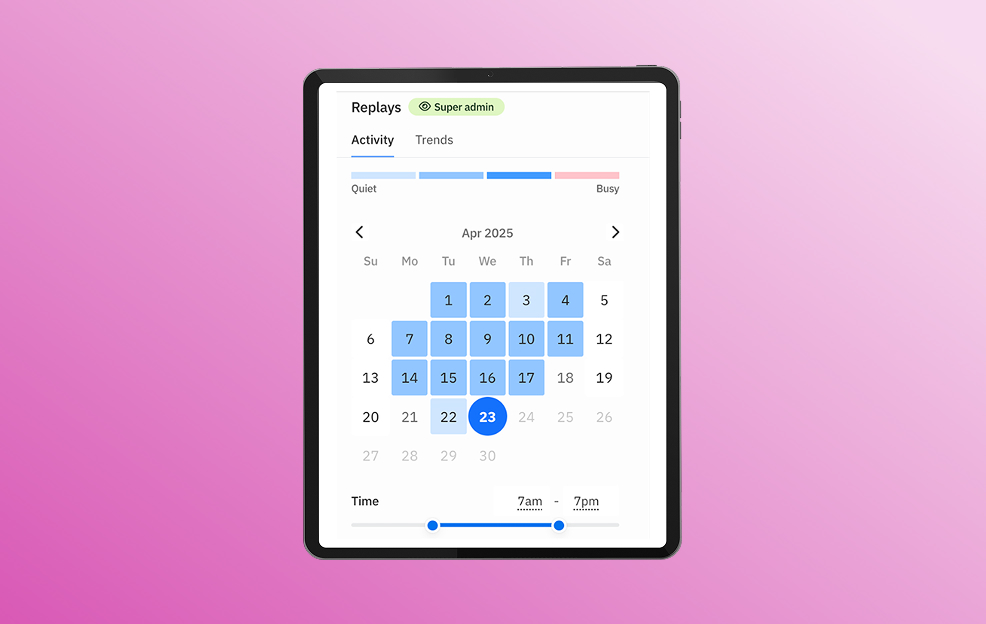
XY Sense also offers a Replays feature, which enables users to visualize office utilization over time through heatmap and detection videos. This enables clients to both validate the accuracy of XY Sense themselves and easily get buy-in from business stakeholders by showing them how the office space is really being used.

Waiting on confirmation of copy

Waiting on confirmation of copy for here and the below slider

Optimize your footprint

Occupancy intelligence systems are an investment, but how do you know that data in your dashboards is correct?  

Learn more

Optimize your footprint

Occupancy intelligence systems are an investment, but how do you know that data in your dashboards is correct?  

Futureproof workplace strategy

Transition from fixed to flexible working with confidence. Allocate space for teams based on occupancy sensor utilization data and take an agile approach to workplace decisions.

Learn more

Futureproof workplace strategy

Transition from fixed to flexible working with confidence. Allocate space for teams based on occupancy sensor utilization data and take an agile approach to workplace decisions.

Supercharge workplace experience

Every workplace and team is unique and so are their space needs.

Learn more

Supercharge workplace experience

Every workplace and team is unique and so are their space needs.

If your team already uses occupancy data for utilization and portfolio planning, this is the next step. 

Join us for a live 45-minute roundtable to learn:

  • How global enterprises use occupancy data across live portfolios, and where the limits sit

  • The consulting view on integration, standards and what actually gets designed into a project

  • Where automation teams draw the line on trusting an external data source

  • What the panel thinks the next five years will demand of building teams

Wednesday 4 November | 10.00 - 10.45am (GMT)