
Welcome to WorkplaceBytes – February 2025, a rundown of articles and reports on the future of work, office occupancy trends, and how workplace leaders like you are blazing new trails as teams adjust to the new workplace.
What’s making news this month?
- Teams use check-ins, office hours, no contact periods to make hybrid work: New data from Gallup reveals the strategies teams are using to make hybrid models effective for them.
- Workplace leaders say transformation, cross-team collaboration, and automation are at the top of their 2025 agendas: Fresh data from CBRE on top priorities among workplace teams.
- In-office work rules and compliance still causing issues for companies and workers: A round up of the many stories, trends, and opinions on…wait for it…RTO and mandates.
- Some Australian workers say WFH is worth up to ⅓ of their salary. Women and higher-income “information workers” value WFH the most.
- Employee-to-desk ratios growing: More proof that 1:1 is increasingly the exception rather than the rule.
Let’s get going!
Hybrid work-in-progress: Teams tackle the balance with check-ins, office hours, and no contact periods
Hyrbid work is still a relatively new science that workplace leaders and their teams are still trying to navigate.
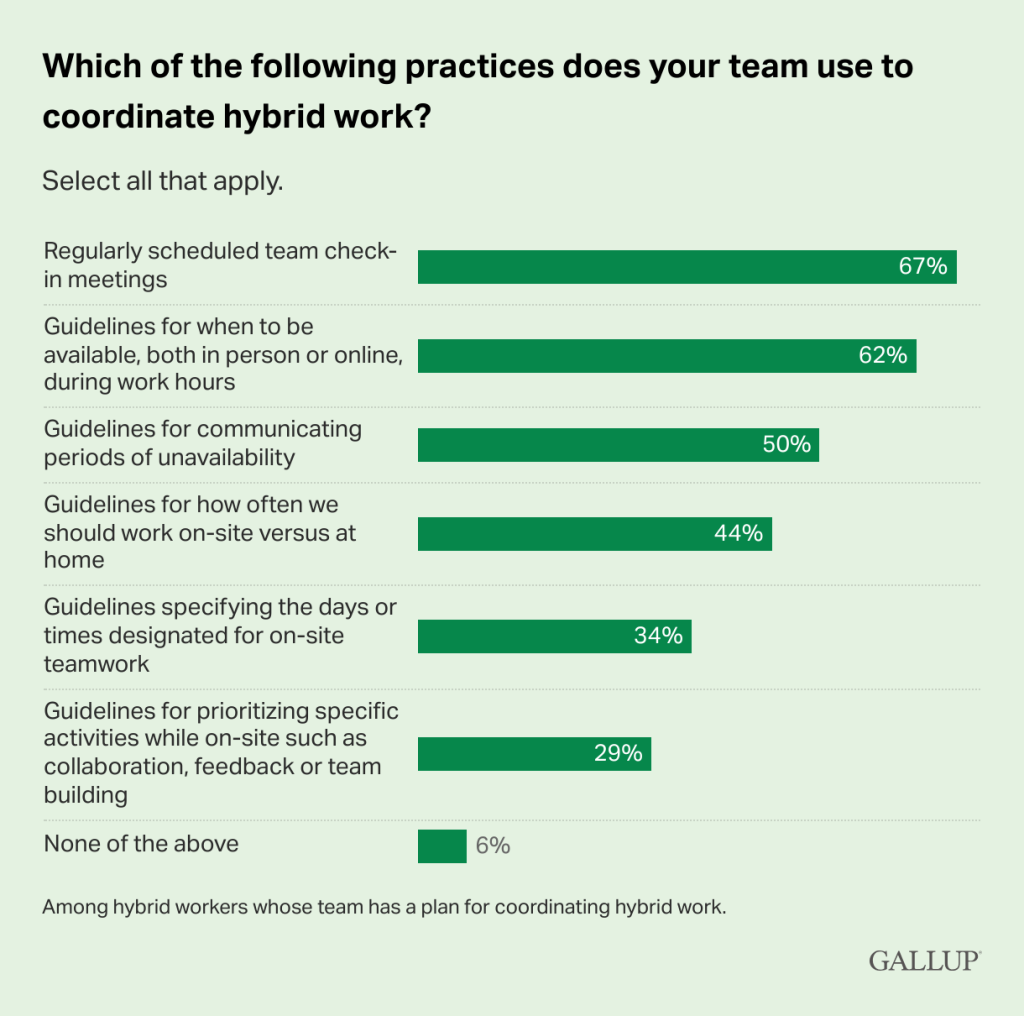
According to recent Gallup research, workplace teams leverage multiple strategies to make hybrid work rules work better for their people.
Among the most popular approaches are regular team check-ins, available and unavailable times of the week, and on-site day guidelines. Other popular strategies include times specifically dedicated to collaboration meetings and prescribing the types of work performed in the office versus at home.
CRE leaders put workplace transformation, cross-team collaboration, and automation at the top of their agendas
CBRE’s recently released Managing Corporate Real Estate: Leading and Emerging Practices shows that workplace teams’ top priorities are business transformation, cross-team collaboration, and automation.
Workplace transformations have been the top focus for CRE for the past four years, and it looks like that trend is here to stay.

In-office work rules and compliance still causing issues for companies and workers
This month, there’s been a lot of talk about companies tightening in-office policies, with some employees pushing back.
Here are a few key highlights:
Another US tech company goes all-in on RTO
Fast Company reports: After testing a 5-day return with some customer-facing teams beginning in September 2024, the company is “retiring” hybrid work rules for most employees as of March 2025.
“The new mandate will apply to all employees who live within about an hour commute of a Dell office—regardless of whether they currently have a remote or hybrid arrangement.”
Michael Dell cited a desire for greater efficiency and communication in an all-company memo:
“What we’re finding is that for all the technology in the world, nothing is faster than the speed of human interaction. A 30-second conversation can replace an email back-and-forth that goes on for hours or even days.”
MIT Sloan Review perspective says the smart money is on hybrid
In a recent piece, MIT Sloan Review Executive Editor Brian Elliot made five predictions about how hybrid work rules will impact the business environment in 2025:
- Organizations that embrace flexible work will steal talent from organizations that impose harsh return-to-office mandates. “RTO mandates lead to brain drain, driving out top talent, especially for women.”
- Forward-looking organizations will shift toward measuring performance based on results, not attendance. “Leaders can step back from ‘management by walking around’ as the default. They can stop monitoring computer activity, a practice that can lead employees to try to game the system.”
- We’ll see the hybrid work conversation shift from days in the office to core hours and focus time. “When companies look at what’s holding their employees back from doing better work, many recognize that a lack of focus time during the workday is a real problem. Author and Georgetown University professor Cal Newport calls this the ‘deep work’ that drives higher-quality outcomes.”
- Leaders will move away from one-size-fits-all hybrid work policies. “You can’t unscramble an egg: If you’ve hired gifted people in a broad variety of locations over the past five years, telling them to move to be centralized will result in massive departures.”
- Flexible organizations will become artificial intelligence innovators. “CEOs and leaders who are willing to invest in experimentation, manage people on the basis of performance, and trust their employees in one sphere — such as working from home — are more likely to do the same when it comes to approaching the adaptation of GenAI and similar tools.”
Survey: Companies struggling to enforce hybrid and 5-day return rules
A Q4 survey from Resume Templates asked 713 businesses about their experiences with RTO policies and enforcement. The data shows:
- 3 in 4 companies are having issues with workers not complying with RTO policy
- 7 in 10 companies will track office attendance in 2025, up ten points over 2023
- 52% of companies report they will be stricter in 2025 about compliance
- Half of business leaders say employees who spend more time in the office are more likely to receive raises and promotions.
So, what do half of these business leaders think is going to encourage more in-office time? “Track office attendance. Build stricter compliance. Ensure that the workers who spend more time in the office are put forward for raises and promotions.”
Flexibility brings more employees to the workforce
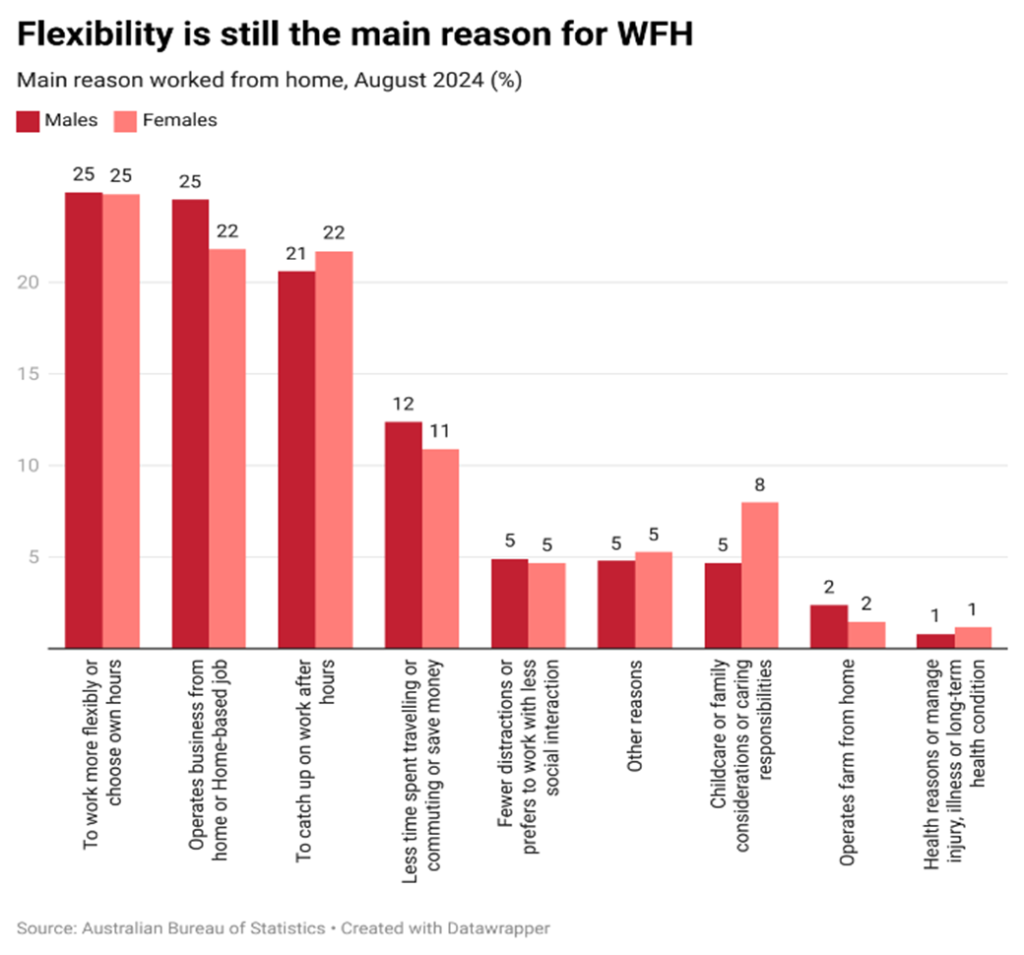
CEDA research cited in Australia’s Financial Review shows that more workplace flexibility has increased workforce participation among those groups with the most challenging schedules and commutes. According to other CEDA research, flexibility is the primary driver of WFH interest:
Some Australian workers say WFH is worth up to ⅓ of their salaries
SmartCompany reports that a fifth of Australians would sacrifice up to ⅓ of their salaries for the right to work from home. This is according to a survey that asked workers to rate the desirability of eight different work rules and salary scenarios. From the article:
“Women valued the ability to work from home far more than men, on average 28% more. This indicates that women are more likely to make a trade-off between long-term career prospects and the benefits of flexible work.
In terms of age, workers in their 30s and 50s valued the ability to work from home the most, while workers in their 20s valued it the least. This might be because workers in their 20s at the start of their careers are the most likely to value direct interactions with their colleagues and supervisors.
Middle and high-income earners in white-collar ‘knowledge economy’ jobs were the most likely to value working from home. They were willing to forgo $12,000 to $24,000 of their annual salary to have the ability to do it some of the time.’
Employee-to-desk ratios growing
As part of its Effective Hybrid Programs: Policies & Common Characteristics report, CBRE shows worker-to-desk averages are growing, with ratios between 1.5 and 2 showing the biggest increases. Higher ratios mean companies can reduce total floor space dedicated to individual desks–either converting it to collaboration space or releasing it in future lease negotiations.
This trend is a natural outgrowth of hybrid and data-driven analysis versus relying on outdated rules of thumb. More aggressive ratios can help workplace teams right-size workspaces and deliver significant incremental ROI if executed using a data-driven approach that conclusively identifies team needs.

The report also provides some interesting insights on how more aggressive ratios increase “office vibrancy,” which they defined as a busy-feeling office with sufficient resources for all:

Definitely worth a look.
That’s it for this month’s edition of WorkplaceBytes. We hope you enjoyed the read.
Sign up here to get this newsletter delivered straight to your inbox.


