

Welcome to WorkplaceBytes – July 2024, a rundown of articles and reports on the future of work, office occupancy trends, and how workplace leaders like you are blazing new trails as teams adjust to the new workplace.
This month’s top stories:
- A Gensler study reveals where and how high performers work. Premium, well-appointed offices, anyone?
- A Bloomberg story on how and why companies are exploring hoteling and hot desking provides insight into how great companies are shaping it to meet company and employee needs.
- Gallup’s latest study on US workplace engagement shows high levels of “actively disengaged” people but highlights how high-performing companies buck the trend. Any guesses about some of the key ways they did that? 😉
- Did you know… Workplace utilization surged 36% in Q1? XY Sense latest edition of the Workplace Utilization Index revealed enormous gains. Will office utilization keep growing back to pre-pandemic levels in Q2? Time will tell.
Let’s dig in.
P.S. Our WorkplaceBytes podcast took a break this month – but will be back in August.
Gensler 2024 Workplace Survey Reveals How and Where High-Performing Employees Work
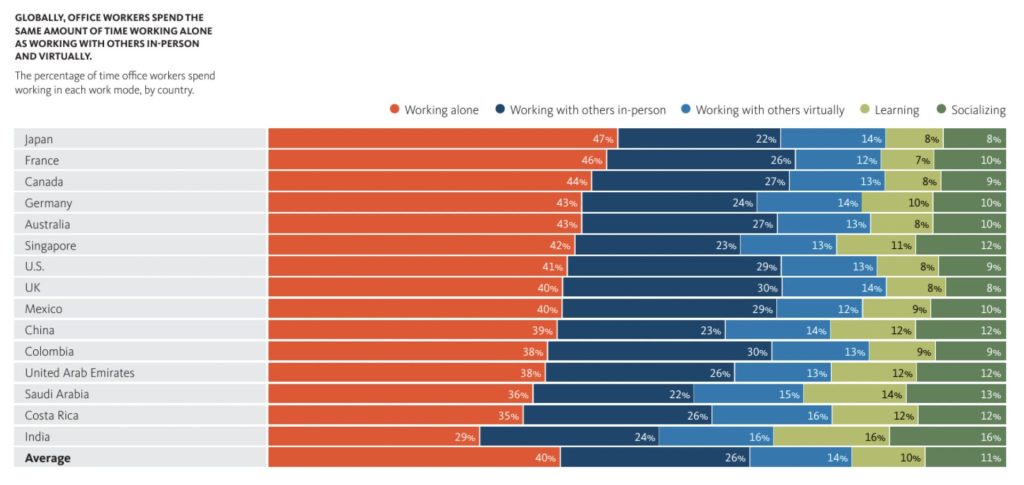
The latest edition of Gensler’s annual survey of workers has been published, and it delivers a great deal of insight into how and where we work. The study of 16,000 workers in 15 countries and ten industries revealed:
Workers everywhere spend more time in group settings (collaboration, learning, socializing) than working alone. In top English-speaking markets (AU, UK, US), the split is about 60% collaboration/40% solo work.
Critical Amenities Make a Difference
Employees in high-performing workplaces have much greater access to critical services and facilities:
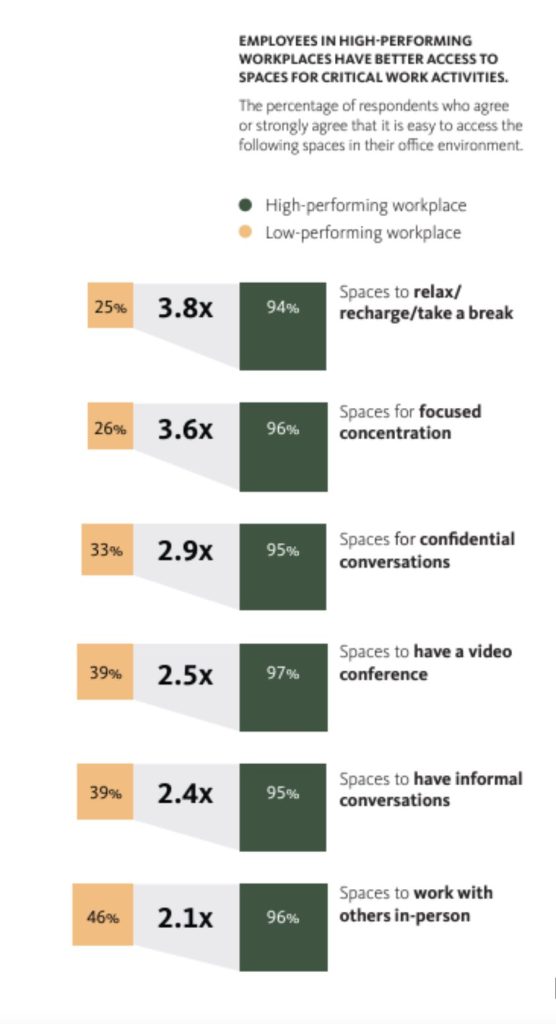
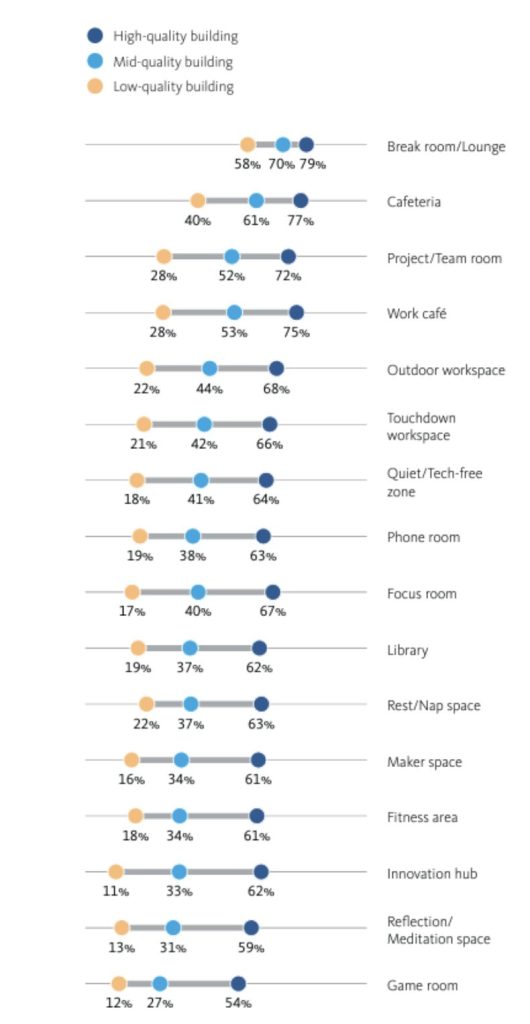
Further, building quality correlates to the availability of critical services and resources. And high performance. According to the study, “Building quality is directly related to workplace quality: high-performing workplaces are twice as likely to be in a high-quality office building. Employees working in higher-quality buildings feel more positively about their company than those in mid- to low-quality buildings.”
This brief Workplace Bytes summary barely scratches the surface of what’s in this major study.
Hot Desking is In, to Some Workers’ Chagrin
Many media outlets are reporting on the increasing adoption of flexible workplace seating models like hot-desking.
A 2023 Morgan Stanley employer survey said hot desking is becoming more common. They say it poses challenges to CRE building owners struggling with tenant downsizing decisions. Business Green reported on new research from IWG pointing to strong adoption of hot desking and hybrid workplace strategies in the UK, which have helped companies cut energy consumption and carbon emissions by 20%.
However, a post from recruiting giant Korn Ferry outlines research that hot desking “breeds discontent” and urges caution when deploying flexible seating approaches.
An article from Bloomberg reports that some companies are ditching hoteling and hot desking, while others are taking more data-driven approaches to address employee issues and concerns. XY Sense client Sanofi is highlighted as an example of a company successfully optimizing hot desk policies to meet team and individual needs. From the piece:
Companies that have stuck with hot desking are doing all kinds of things to make it easier on employees. French pharmaceutical giant Sanofi SA began sharing desks in 2017 to better utilize its space. When it redesigned its office in Cambridge, Massachusetts, it settled on just one desk for every two employees. Even Sanofi’s scientists have to share lab benches.
To help make it work, the Sanofi office has a range of workspaces — privacy booths, small huddle rooms, large open tables — and even a “hospitality ambassador” who can address employees’ needs, according to Fernando Faria, Sanofi’s global head of workplace transformation.

Downtowns Reviving with RTO and Transformation
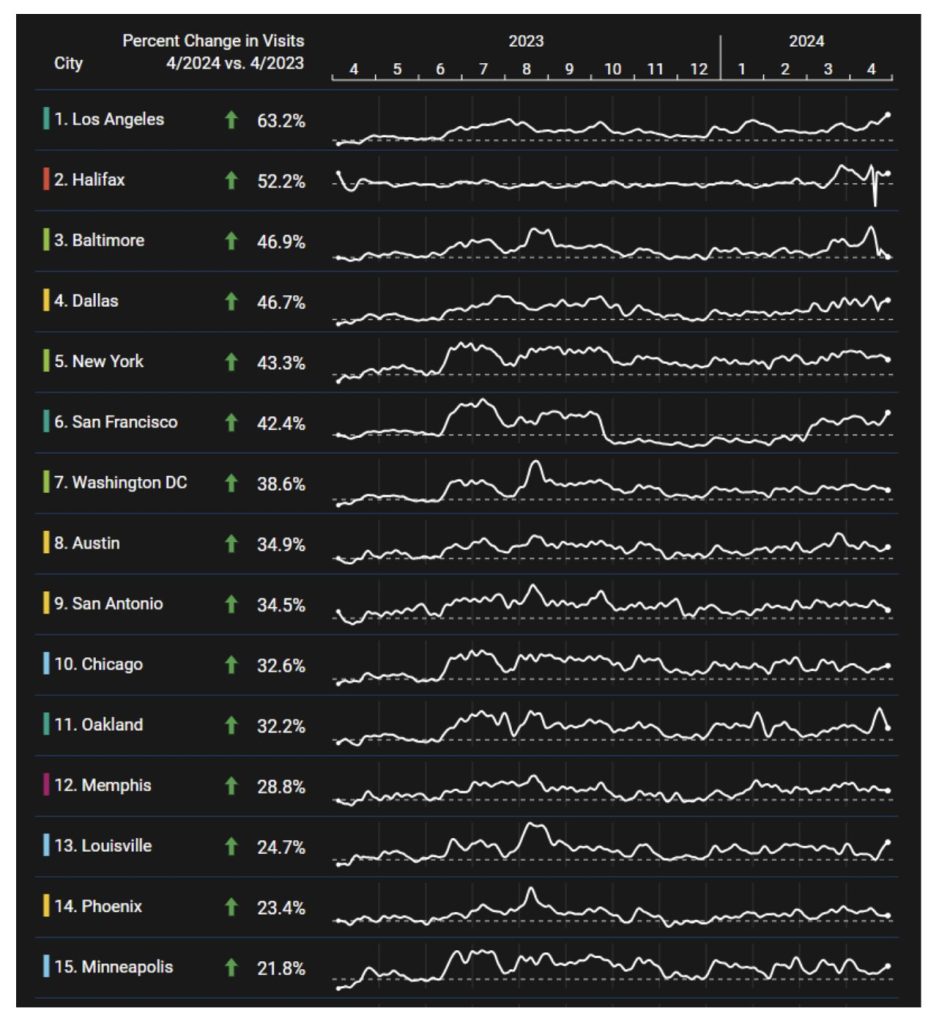
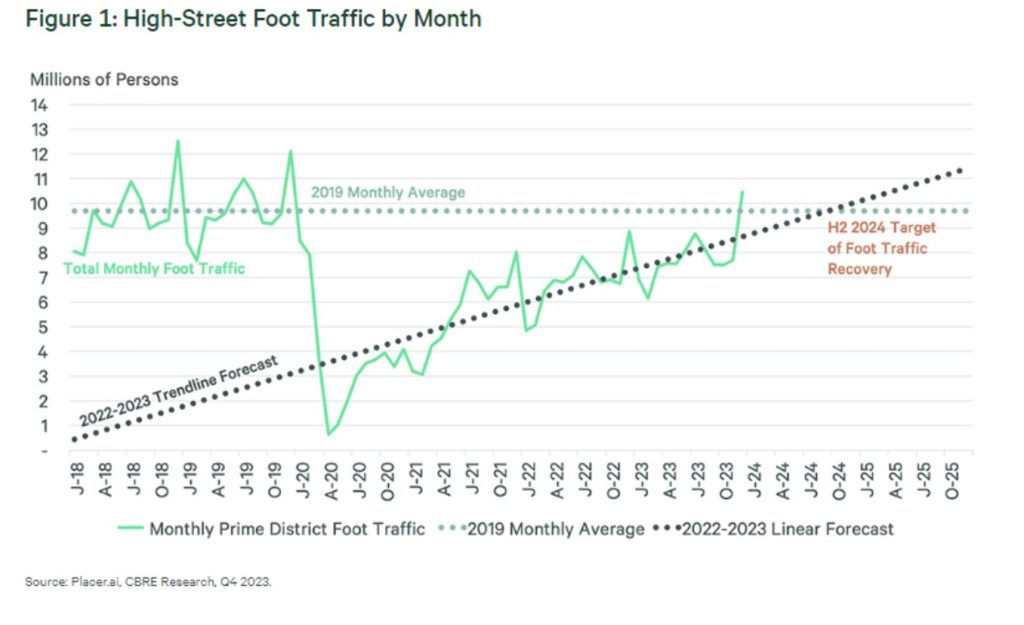
A University of Toronto study examined rates of downtown visitation in 64 US and Canadian DMAs and saw encouraging signs that urban cores are becoming healthier and livelier. 52 of 64 city downtowns studied saw year-over-year increases in visitation. Top winners:
The gains aren’t all about workplace attendance. A widely praised 2023 study from Central Philadelphia Development Corporation (CPDC) and Center City District Foundation (CCDF) showed multiple drivers, including:
- RTO Worker Visitation (65% recovery as of Q4 2023 reflecting hybrid work schedules)
- Visitors (Individuals, Tour Groups, and Conventions) (81% recovery)
- CBD Resident Population Growth (111% of pre-pandemic levels for the 26 cities studied)
The study underscores the importance of accurate data in making the right decisions to drive further foot traffic increases.
Many cities have initiated efforts to drive more people downtown with entertainment, festivals, and other inducements. San Francisco’s mayor, London Breed, recently made headlines with her proposal for major entertainment initiatives to drive traffic to the city’s still relatively quiet downtown.
Ongoing research from CBRE shows that the revival of downtowns is a long-term trend.
Gallup Annual Engagement Survey Shows a Big Problem and a Bigger Solution
Every year, research leader Gallup surveys tens of thousands of workers worldwide on how much they are engaged in their work and connected to their companies’ missions.
The study classifies workers into four key groups: An “Engaged” employee is involved in, enthusiastic about, and committed to their work and workplace. “Actively Engaged” people are the most Engaged. On the flip side, Disengaged people are not connected and enthusiastic. Actively Disengaged people are sometimes so frustrated that they work to undermine their employers.
Through Gallup Daily tracking, Gallup categorizes workers as “engaged” based on their responses to key workplace elements that correlate or predict important organizational performance outcomes. This year’s data show some troubling trends in the US. The percentage of Engaged employees is down, and the number of Actively Disengaged employees has ticked up.
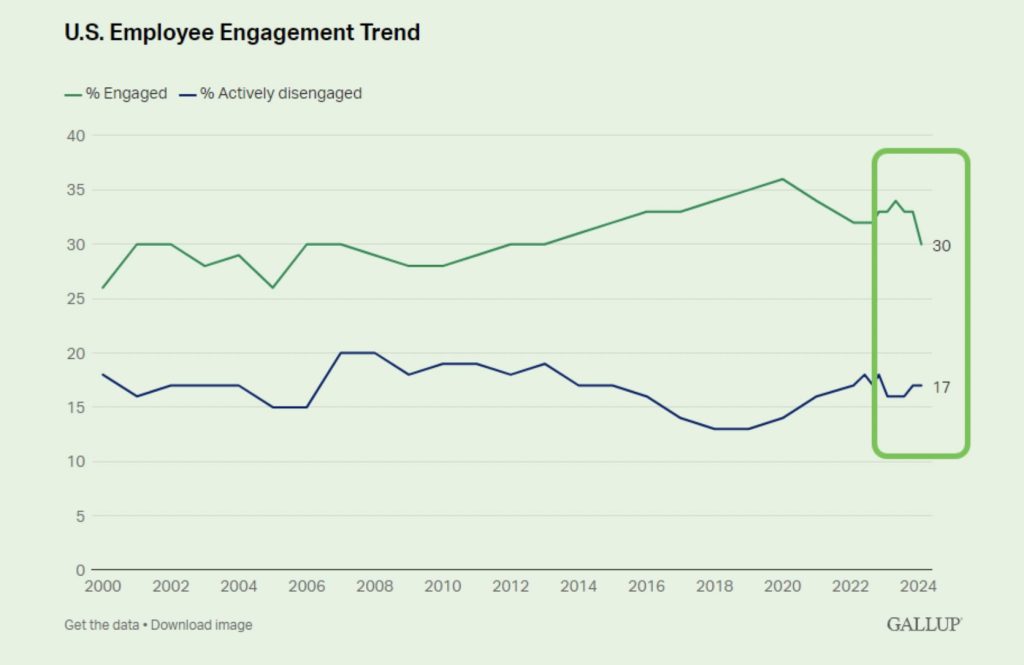
Not every company is seeing these challenges. According to Gallup, the best performing companies buck the trends. One of the biggest factors is having a great hybrid work policy that is designed for the workstyles and work needs of teams. This Gallup article explains how leaders can create positive policies and environments.
Workplace leaders must focus on human-centric design
Gartner recently published strong advocacy for a “human-centric” approach to workplace footprints and design. Their viewpoint advocates a shift from office or building-centric planning to human-centered planning. Their data show that employee engagement is a huge driver of top company performance.
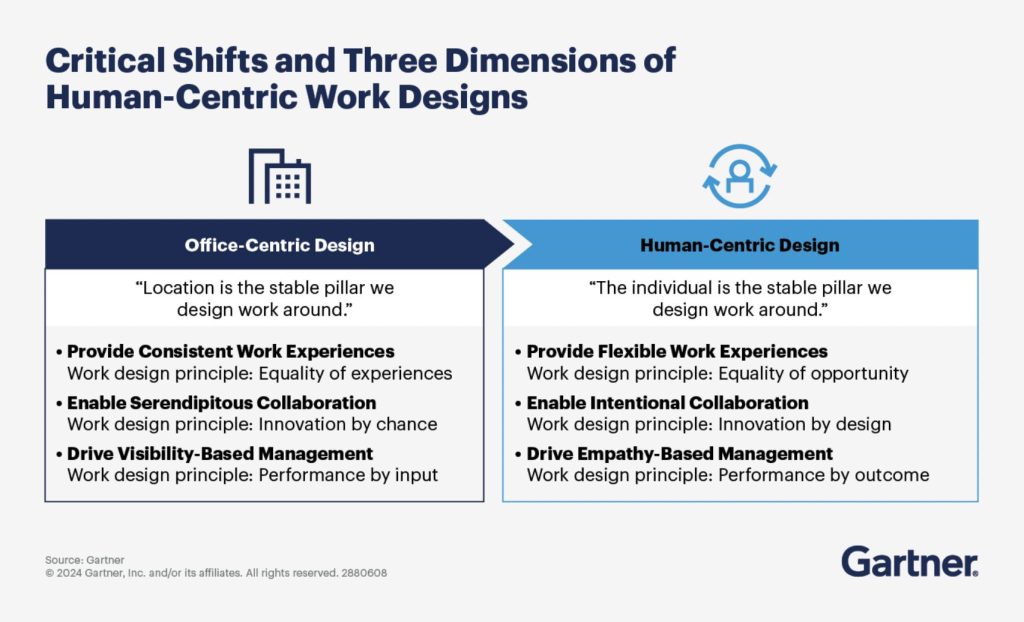
They say the keys to successful human-centric design are flexible work, intentional collaboration, and empathy-based management. This recent CBRE post says that flexibility, inviting spaces, and thoughtful design are essentials for creating more productive work environments. Said Jenny Liu, CBRE Director of Workplace Consulting,
Workplace experience is key to enticing people back to the office and these strategies fall under the key categories of people, place and technology. A workplace experience isn’t just environment, cool furniture and tech anymore. It’s the culture, ways of working, leadership, and how vibrancy is created. This is crucial because people are your most valuable asset, not your real estate footprint and office space.”
Did you know? Global Workplace Utilization Jumped 36% in Q1
The latest edition of the XY Sense Workplace Utilization Index (WUI) showed that office utilization spiked by over a third in Q1. This huge gain came after three quarters of flat utilization in 2023.
The top drivers:
- Economic uncertainty is rebalancing the power relationship between workers and companies after several years of a strong “seller’s market.” This is making workers more willing to follow company hybrid work guidelines. The balance is returning after a couple of years of unprecedented worker power.
- Workers recognize the unique value of coming into the office, especially for developing social connections, gaining expertise and training, improving team collaboration, and progressing in their careers.
- Incentives for workplace attendance are increasing. Companies are shifting their strategy from “sticks” to “carrots.”

Utilization increased by 25%+ across all tracked regions
All regions saw utilization growth, with the UK leading the pack. While North American utilization continues to lag the rest of the world, it also saw a 27% increase.

There’s lots more information in the Q1 2024 WUI.
Explore all the report’s insights on XYSense.com or download your copy now.
That’s it for this month’s edition of WorkplaceBytes. We hope you enjoyed the read.
Signup here to get this newsletter delivered straight to your inbox.


